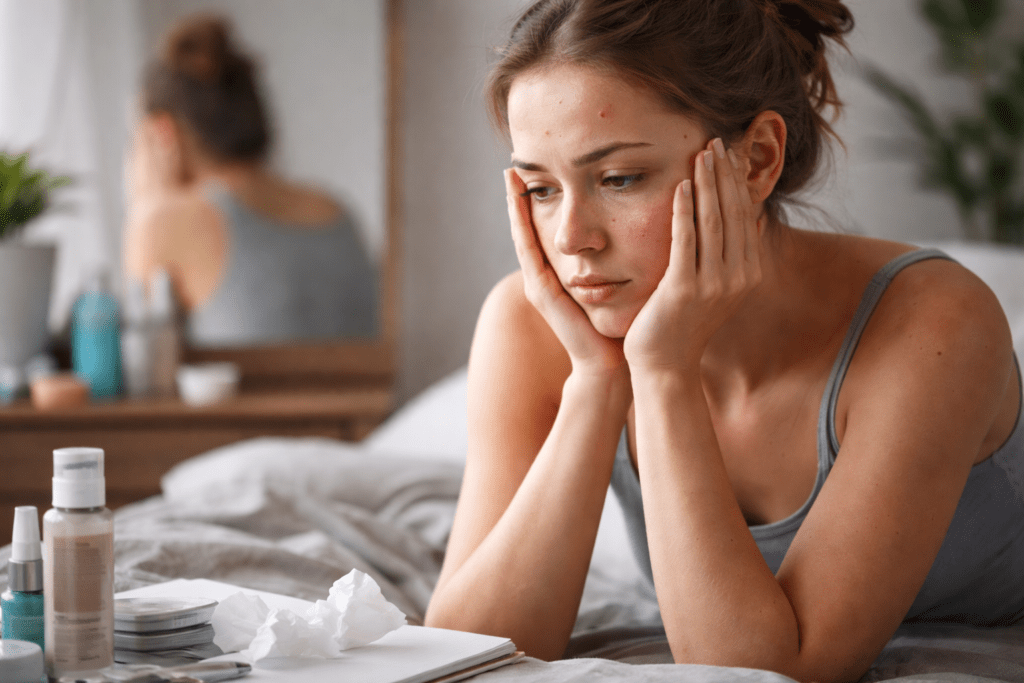
A 27-year-old female presented with concerns regarding persistent acne and anxiety. Her acne had first appeared around the age of 14 and had remained a chronic issue since. The breakouts were primarily located on the forehead, chin, and along the jawline. Over time, the condition had begun to significantly affect her self-esteem and contributed to increasing social anxiety and withdrawal. She described feeling uncomfortable in social situations and often worried that others were judging her appearance.
The patient also reported a growing sense of frustration and health anxiety surrounding the acne. She felt she had “tried everything” and considered herself to be “one of the healthiest people she knew,” yet her skin had never cleared.
PREVALENCE
This patient is far from alone in her struggles with acne and the psychological impacts it has. Acne affects approximately 85% of individuals aged 12-24 years and approximately 50% of people aged 20-29 years. 26% of women and 12% of men report acne in their 40s. One study found that 64% of those aged 20-29 years and 43% of those aged 30-39 years had visible acne. It’s incredibly common and unfortunately has a major impact on mental health. A meta-analysis found a significant association between acne and depression (22%), anxiety (29%), and suicidal thoughts (12%).
PREVIOUS TREATMENT
Over the years, the patient had consulted multiple primary care physicians, dermatologists, and aestheticians. She tried numerous conventional treatments, including topical antibiotics, tretinoin, oral antibiotics, and oral contraceptive pills. She had also been prescribed several medicated cleansers and topical serums.
In addition to medical treatments, she had pursued cosmetic procedures such as microdermabrasion and other aesthetic treatments. She had experimented extensively with various skincare products and regimens, including niacinamide, retinol, vitamin C serums, witch hazel, bentonite clay masks, and multiple cleansing routines. She even experimented with her diet; she tried being gluten-free, then dairy-free, then vegan. She tried drinking a gallon of water daily, dry brushing, cold showers, and more. Despite these efforts, her acne persisted.
The patient reported that she first became aware of naturopathic medicine after watching a YouTube video, in which someone described clearing their acne after working with a naturopathic doctor. Curious, she searched online and scheduled an appointment.
HEALTH HISTORY
A detailed intake was performed, including a review of sleep, stress, diet, exercise, and other determinants of health.
One of the most notable findings was her irregular sleep schedule. She frequently stayed up late and often woke up late in the morning. During periods of academic stress, she would occasionally pull all-nighters to complete assignments. She also reported difficulty falling asleep due to racing thoughts.
The patient described chronic stress related to school, work, frequent moves, and family issues. She maintained an active lifestyle and reported running or practicing yoga most days.
Her diet was vegan but consisted largely of processed foods and refined carbohydrates. She reported frequently consuming pasta, bread, and potatoes. At times, fast-food items such as French fries served as a primary meal. Beverage intake included soda, kombucha, approximately 40 ounces of coffee daily with creamer, and an average of four to eight alcoholic beverages per week.
At the time of presentation, she was not taking any medications or supplements.
ADDITIONAL FINDINGS
During the review of systems, the patient reported irregular menstrual cycles accompanied by significant cramping that occasionally caused her to miss work or school. She also reported a prior history of a right-sided ovarian cyst.
Taken together, these findings suggested that several lifestyle factors, particularly circadian rhythm disruption, chronic stress, and blood sugar instability, could be contributing to the persistence of her symptoms.
TREATMENT PLAN
The treatment plan focused on restoring physiologic balance through foundational naturopathic principles.
Nutritional guidance was provided with specific protein and fiber goals and an emphasis on blood-sugar-balanced meals. The patient was encouraged to decrease soda and alcohol intake and to increase hydration, to consume approximately half her body weight in ounces of water per day.
Guidance was also provided to support stress management and circadian rhythm regulation.
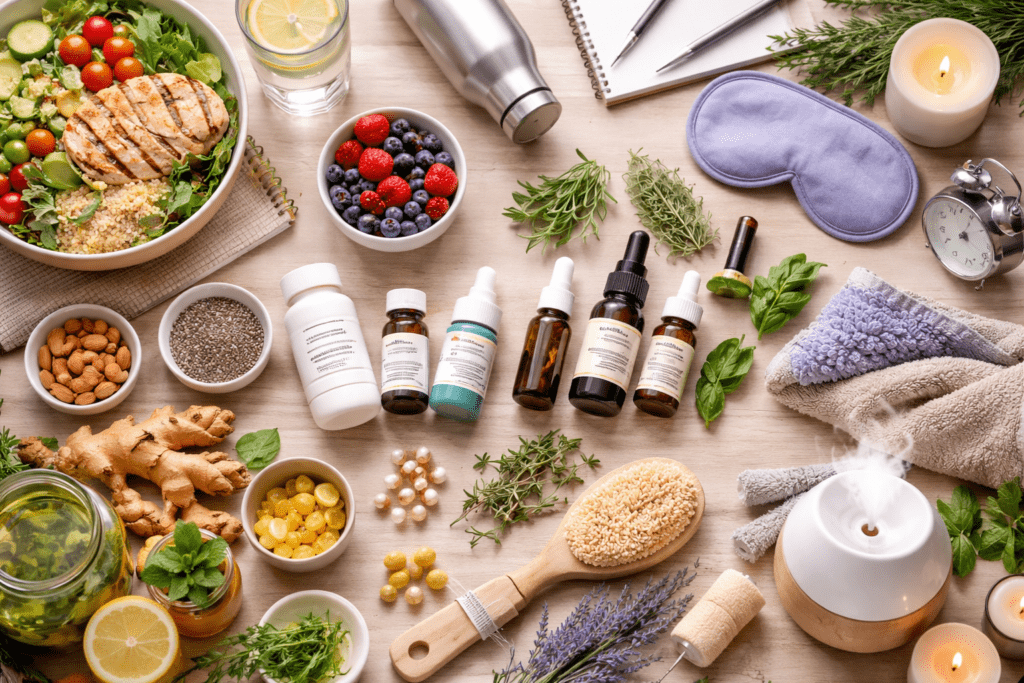
Therapeutically, the patient was started on a protocol that included biotherapeutic drainage using UNDA remedies, a probiotic, multivitamin, vitamin D supplementation, and adaptogenic herbs. Daily contrast hydrotherapy in the shower was recommended as an additional supportive therapy.
FOLLOW-UP
At her 1-month follow-up appointment, the patient reported significant improvement in several areas.
Her skin had cleared almost completely (~80%), with only minor breakouts occurring around the time of her menstrual cycle. She also reported improved sleep, increased and more stable energy, and greater ability to concentrate and focus.
Her menstrual cycle had occurred on day 28, with minimal cramping. She reportedapproximately 90% improvement in PMS symptoms.
Her anxiety had improved by roughly 60%.
At this point, a constitutional homeopathic remedy was added to further support her mental health, and she was encouraged to continue the treatment plan for another month.
LONG-TERM OUTCOME
It has now been 3 years since the patient first presented to the practice. She continues to follow up occasionally for maintenance care or during episodes of acute illness.
Her acne is no longer an issue. She reports that her anxiety has improved by approximately 95%. While she occasionally experiences mild anxiety before significant events, such as giving a public talk, she describes it as completely manageable compared to the debilitating anxiety shepreviously experienced. She states that she “feels like she’s been given her life back,” which is exactly why I love practicing naturopathic medicine so much!
Start your healing journey with us…
References
Management of Acne Vulgaris: A Review. The Journal of the American Medical Association.2021. Eichenfield DZ, Sprague J, Eichenfield LF.
Acne Vulgaris. The New England Journal of Medicine. 2018. Zaenglein AL.
Acne Vulgaris. Lancet. 2012. Williams HC, Dellavalle RP, Garner S.
Acne Vulgaris and Risk of Depression and Anxiety: A Meta-Analytic Review. Journal of the American Academy of Dermatology. 2020. Samuels DV, Rosenthal R, Lin R, Chaudhari S, Natsuaki MN.
Global Prevalence of Mental Health Comorbidity in Patients With Acne: An Analysis of Trends From 1961 To 2023. Clinical and Experimental Dermatology. 2025. Chen Y, Sun S,Yang H, et al.
Sleep Quality, Circadian Preferences, and Mood Among Patients With Acne Vulgaris: A Case-Control Study. Sleep & Breathing = Schlaf & Atmung. 2023. Zhu J, Peng K, Zhang Y, et al.
Association of Lifestyles and Mental Health With Adult Acne: A Population-Based Cross-Sectional Study. Journal of the European Academy of Dermatology and Venereology: JEADV.2026. He J, Ning N, He S, et al.New
The Relationship of Quality of Life and Acne Severity With Chronotype and Insomnia in Patients With Acne Vulgaris. Archives of Dermatological Research. 2023. Güler D, Soylu S,Güler HA.
Dietary Glycemic Factors, Insulin Resistance, and Adiponectin Levels in Acne Vulgaris. Journal of the American Academy of Dermatology. 2016. Çerman AA, Aktaş E, Altunay İK, et al. D
Guidelines of Care for the Management of Acne Vulgaris. Journal of the American Academy of Dermatology. 2024. Reynolds RV, Yeung H, Cheng CE, et al.Guideline
Association Between Adult Acne and Dietary Behaviors: Findings From the NutriNet-SantéProspective Cohort Study. JAMA Dermatology. 2020. Penso L, Touvier M, Deschasaux M, et al.
Society for Endocrinology Clinical Practice Guideline for the Evaluation of Androgen Excess in Women. Clinical Endocrinology. 2025. Elhassan YS, Hawley JM, Cussen L, et al.NewGuideline
Consensus on Women’s Health Aspects of Polycystic Ovary Syndrome (PCOS): The Amsterdam ESHRE/ASRM-Sponsored 3rd PCOS Consensus Workshop Group. Fertility and Sterility. 2012. Fauser BC, Tarlatzis BC, Rebar RW, et al.Guideline
The Association of Glucose Metabolism Disorders and Acne in Women With Polycystic Ovary Syndrome (PCOS). In Vivo. 2025. Damoulaki E, Sioutis D, Georgiadi EP, et al.
Safety and Effectiveness of Oral Nutraceuticals for Treating Acne: A Systematic Review.JAMA Dermatology. 2023. Shields A, Ly S, Wafae B, et al.
A Randomized Clinical Trial to Evaluate the Efficacy of an Oral Probiotic in Acne Vulgaris. Acta Dermato-Venereologica. 2024. Eguren C, Navarro-Blasco A, Corral-Forteza M, et al.
Efficacy of Oral Probiotics in Patients With Acne: A Systematic Review and Meta-Analysis of Randomized Trials. Clinical and Experimental Dermatology. 2025. Lin HW, Tam KW, HuangYC.New